What 'Made with Intention' Actually Means: A Look Inside the Nicole Moon Designs Studio
You've probably seen the phrase "intentionally crafted" tossed around a lot lately. It shows up in brand copy, Instagram captions, and product descriptions across the entire fashion spectrum — from independent designers to major retailers trying to soften their image. But what does it actually mean when a brand says their work is made with intention?
For Nicole Moon Designs, it's not a tagline. It's a process. And that process has a beginning, a middle, and a whole lot of deliberate decisions along the way.
Inspiration Doesn't Come from a Trend Report
Let's start at the very beginning: where ideas come from.
At a lot of fast fashion companies, the design process starts with a trend forecast — a report generated months in advance that tells designers what colors, silhouettes, and styles are projected to sell. It's efficient, but it's also the reason you'll see the same "it" piece replicated across fifty different stores at the same time.
Nicole Moon Designs doesn't work that way. Inspiration here tends to arrive more organically — through art, through nature, through the quiet observation of how real people actually move through their lives. The moon itself is a recurring reference point: its phases, its light, the way it pulls at things. There's a visual poetry to that imagery that translates into design in ways that are subtle but consistent.
Other touchstones include architecture, textiles from independent artisans, vintage American workwear, and the kind of understated elegance that doesn't announce itself loudly. The goal is never to chase a moment — it's to create something that feels timeless enough to outlast one.
The Fabric Question: Where Most Brands Cut Corners
If you want to understand the difference between a thoughtfully made garment and a mass-produced one, start with the fabric.
Material selection is one of the most consequential — and most overlooked — parts of the design process. Fast fashion relies heavily on cheap synthetic blends that look decent on a hanger but degrade quickly with wear and washing. They're cost-effective for the brand, but they end up costing the consumer (and the environment) more in the long run.
At Nicole Moon Designs, fabric sourcing is treated as a creative act in itself. Every material is evaluated not just for how it looks, but for how it feels against skin, how it drapes on a body in motion, how it holds up over time, and where it comes from. Natural fibers — linen, cotton, wool, and silk — are prioritized when possible. When synthetics are used, there's a reason for it: performance, structure, or durability that a natural fiber can't provide in that specific application.
The sourcing process takes time. It means passing on materials that look good on paper but don't hold up to closer inspection. It means paying more per yard to work with suppliers who share the same standards. None of that shows up on a hang tag, but it shows up in how a piece feels the hundredth time you wear it.
Small-Batch Production: Why Less Is Actually More
One of the defining characteristics of Nicole Moon Designs is the commitment to small-batch production. This isn't a marketing angle — it's a structural choice that shapes everything from quality control to creative freedom.
When you're producing hundreds of thousands of units, consistency becomes the enemy of craft. You need processes that can be replicated mechanically, at speed, with minimal variation. That works great for certain industries. It doesn't work great for fashion that's trying to be genuinely original.
Small-batch production means each run is limited. It means more hands-on attention at every stage. It means that when something isn't right — a seam that's slightly off, a color that didn't come out quite as expected — there's room to catch it and correct it rather than ship it anyway because the quota needs to be hit.
It also means that when you buy something from Nicole Moon Designs, you're not going to run into five other people wearing the exact same piece at a rooftop party in Brooklyn. That exclusivity isn't about gatekeeping — it's a natural byproduct of making things carefully and in limited quantities.
The Design-to-Production Journey
Here's a rough picture of how a piece moves from concept to closet at Nicole Moon Designs.
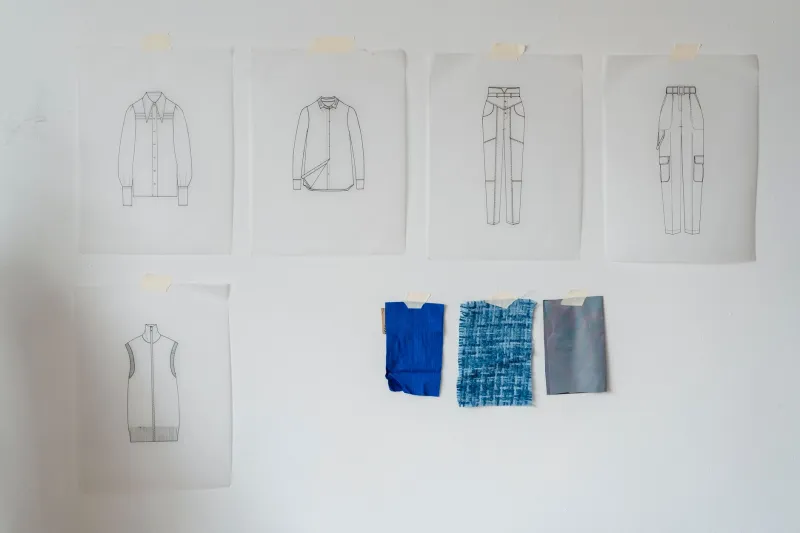
It starts with a sketch — sometimes digital, sometimes hand-drawn — that captures the core idea. From there, the design goes through a round of refinement: proportions get adjusted, details get reconsidered, and the relationship between form and function gets worked out on paper before anything is cut.
Then comes the sample phase. A first sample is made up in the chosen fabric, and this is where the real editing happens. Does the silhouette work the way it was supposed to? Does the fabric behave the way it should when it's actually sewn? Samples get worn, washed, and evaluated before any production decision is made.
Once a sample is approved, production begins — again, in small batches. Finished pieces go through quality review before they're ever packaged or shipped. It's not a glamorous part of the process, but it's an essential one.
The whole journey from initial concept to finished product can take months. That's intentional too.
What You're Really Buying
When you invest in a piece from an independent brand like Nicole Moon Designs, you're not just buying a garment. You're buying into a set of decisions — decisions about materials, about process, about what kind of fashion ecosystem you want to support with your dollars.
In the US, the conversation around fast fashion and its impact has gotten louder in recent years, and for good reason. Americans buy roughly 68 garments per year on average, and a significant chunk of those end up in landfills within a few wearings. The math on that — financially, environmentally, culturally — doesn't add up.
Choosing pieces that are made with care and built to last is one of the most straightforward ways to opt out of that cycle. It usually means spending more upfront, but it also means owning things you actually want to keep.
At Nicole Moon Designs, the ambition has always been to create pieces worth keeping. Not just because they're well-made — though they are — but because they're genuinely original. Because they were designed by someone with a point of view, not generated by an algorithm. Because they carry the kind of quiet confidence that comes from knowing exactly what they are.
Craft Is a Choice
In contemporary fashion, craft is a choice — and it's one that gets harder to make as the pressure to produce more, faster, and cheaper intensifies across the industry.
Nicole Moon Designs chooses craft anyway. Not out of nostalgia, but out of a real belief that the things we wear every day deserve to be made well. That original design matters. That the person wearing the piece deserves more than a garment that falls apart by next season.
That's what "made with intention" means here. Not a phrase. A practice.